
Before the sweetness, the cost.
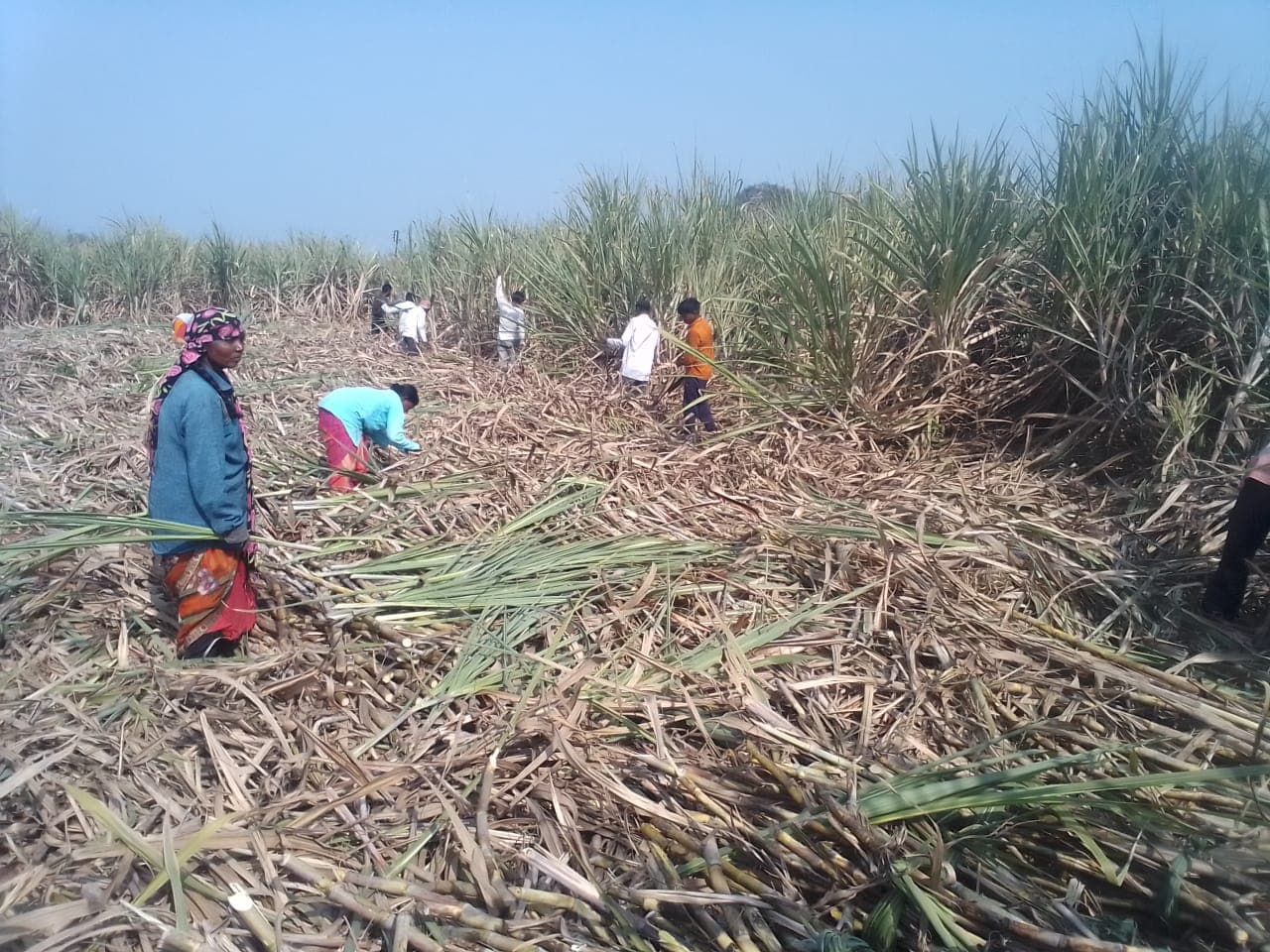
The sugar in India's tea is cut by hand, by families who leave everything behind for six months and are counted by almost no one. Here is what the record actually shows.
There is no official census of India's sugarcane cutters, so every number here is drawn from government committees, legislature records, peer-reviewed surveys and field studies, and cited below. Where a figure is an estimate, we say so.
An entire population on the move.
Each crushing season, families from Marathwada, north Maharashtra and Vidarbha follow the cane. This is the scale of that exodus.
people are estimated to migrate every harvest season to cut Maharashtra's sugarcane
Oxfam India, ‘The Human Cost of Sugar’ · 2020of them come from Beed district alone, a single district carrying the weight of the whole industry
Oxfam India, ‘The Human Cost of Sugar’ · 2020They are recruited by contractors (mukadams) as husband-and-wife pairs, a ‘jodi’, or ‘koyta’ after the sickle they carry. The contract is verbal. A cash advance (uchal) of ₹50,000 to ₹2 lakh binds the couple to the season; a missed day is fined (khada) ₹500–₹1,000, often more than a day's wage. They cut for roughly six months, twelve to sixteen hours a day, around a tonne of cane each.
A womb removed to keep cutting.
The best-documented part of this crisis is what it does to women. To avoid losing wages to menstruation, pain or infection at camps with no healthcare, thousands undergo hysterectomies, many needless, many at private clinics.
women in one Beed survey of 82,309 had undergone a hysterectomy
Govt. of Maharashtra committee (Gorhe Committee), reported by ThePrint · 2019of the surveyed migrant women in Beed had had their womb removed, around 12 times the national average
Govt. of Maharashtra committee (Gorhe Committee), reported by ThePrint · 2019hysterectomies in just three years at 99 private hospitals in Beed district
Maharashtra Legislature (Health Minister’s statement), via SPRF · 2019of women in migrating households had undergone a hysterectomy, against 17% in non-migrating ones
IIED household survey, Beed · 2024No toilet. No water. No let-up.
A survey of over a thousand women cane cutters found conditions that would be unthinkable anywhere with a fixed address.
of women cane cutters had no toilet at their workplace
MAKAAM ‘Crushed Hopes’ study, via Behanbox · 2019–20were left to use cloth rags during menstruation, with no clean facilities
MAKAAM ‘Crushed Hopes’ study, via Behanbox · 2019–20Drought pushes; debt pulls.
This is distress migration. Failing rains and farm debt across Marathwada leave families with little choice but to hand themselves to a contractor for the season. Cutting cane is rarely a livelihood people choose, it is the one they are left with.
Figures are reproduced from the sources listed here and were fact-checked against them. Migration totals are estimates, no official count of seasonal cane migrants exists, and are attributed to their source. Economic figures date from 2019–2022 and may since have risen.
We publish these numbers not to shock, but because a problem uncounted is a problem ignored. Abhijeet Sevabhavi works in exactly this belt, Parbhani, Hingoli and the districts around Beed, with the families behind these figures.
Numbers become names when someone shows up.
This is the scale of the problem. Our work is the response, and it grows with every person who joins it.